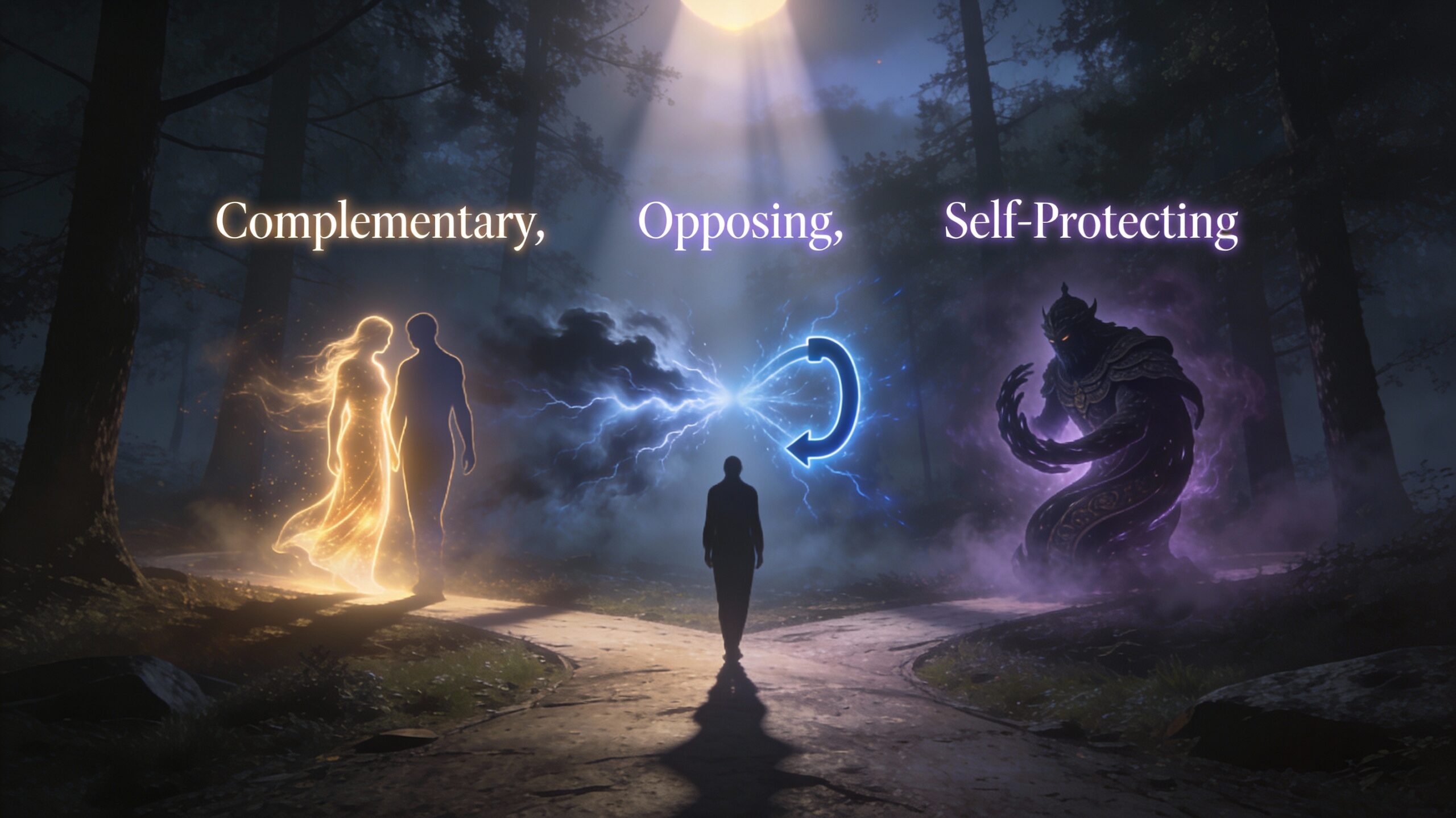

Last Sunday, while doing a morning walk, after a long journaling session, I was hit with the realization that our internal shadows can be categorized. I felt intrigued and followed my thinking thread – or maybe I followed the divine downloads? Who knows, but here is the result: 3 categories of shadow work that might save you some headache the next time you need to face the unruly choice you’ve made.
For all my judgmental people out there, don’t forget: the judgment you might cast out is nothing more than a reflection of one of your own shadows inside, which begs you to be finally healed.
Complementary shadow
The first category I call the “complementary shadow.” This is a very common one. We usually go along with it without realizing that it is not good for us. For example, when I grew up, I was taught the role of the problem fixer. Any problem, I solved. Not that one really taught me that – as my sister assumed other roles – I took that role as I saw it most fit to protect myself best with it. Throughout the last decade, I shed light on it, and with time, more and more I changed – so much so that I thought it was gone. Nonetheless, some strong residual was hidden. It was just lying low, as I gave it no outlet. With meeting my ex, it roared back to life. I assumed once more the role I held around my loved ones, the one I was best at: the people fixer.
In retrospect, I see how I was assuming that role in every ounce of my life. I fixed business problems as my main job, I fixed people’s job problems as my side hustle, and I was constantly and with pride fixing myself at the center of my personal mission. (I still do, but not for worthiness points, but for fun.) Surely enough, I attracted my ex, who – of course, how could it have been different – needed fixing too. On the other side of a people fixer is often a person with wounds (feeling not seen), leading them into narcissistic behavior. Surely enough, we both met our match – a match made in heaven, well, in the shadows. I guess you can easily see why I called them complementary shadows. Acting in line with the shadow feels familiar and was at first even soothing to both of us. Yet, shadows are shadows, and with time, all the negative side effects kick in. The way out of them is either both heal, both suffer ongoingly, or one heals and leaves.
When looking at that from an analysis perspective, one can see it’s not easy to spot this type of shadow. At first, it feels very familiar, often established at a young age through toxic (family) patterns or childhood trauma. Over the first few weeks, months, or even years, it can sometimes feel very normal from a subjective viewpoint. Usually, one starts to defend the situation when other people point out that something is amiss. Some initial indicators can be a gut feeling that something is amiss, particularly if one has already experienced a period of complete peace, but the shadow will protect itself, and you will argue with yourself. At some point in time, you start to suffer. Still, you might argue with yourself to keep going on, but it feels like a sacrifice. That is the major indicator that the situation at hand is, in fact, a (subconscious) shadow. This is the moment you should start to investigate (see approach in the last chapter).
Opposing Shadow
The second category I call “opposing shadow.” This is actually the more fun one because it sets your nervous system into a frenzy just when you meet your opposing shadow. And I don’t mean fun in a funny way, but fun in a scary-emotional way. It’s more like magnets of the same polarity. Opposing shadows are usually triggered by another person or situation – something outside of us. When you meet, both parties will be triggered and often run. (Sidenote: If one person is not triggered at all by you, they usually sense that the other is triggered. They stay calm or ask logical or soothing questions – and then you run…) Now, let’s jump into a funny-scary example from my own life: Back then, I was super-fresh in Dubai, not even a month, I think. I had just started dating, and one of my first dates was a filthy-rich guy – at least it seemed so back then, from the perspective of my limited German mind on wealth. The party had already started when he picked me up. He came in a supercar – and I got really angry. Until that day, I had never been in a supercar. Surely enough, I had driven a BMW M4 a few times, but nothing comparable to this beast. My shadow of not earning enough money was ringing like war sirens, and it was expressed in hot anger. My body went into a kind of lockdown – or maybe fight mode?-, and my first word was a sassy comment about ‘only picking me up to parade his car in front of me’. My anger spiked as he looked stunned, and I thought, Oh boy, you are surprised that you can’t buy me with a fancy car? I guess that exchange, and maybe the frequency, affected him, too. Lol, it took mere 15 seconds to offend my date without any reason – except my own shadows. He was visibly stunned, and now I think he even felt rejected. And as it is with opposing shadows, it went along the entire date – and I felt the effects long after.
I guess we were just the perfect opposing-shadow tandem. I was triggered by the reflection of my inner shadows – basically, around worthiness – as he might be too. How fun, don’t you think? In retrospect, he was a good guy, and I even admired (and integrated) his directness, particularly with his friends, as I, as a still-people-fixer, was scared of being that type of person privately. Anyhow, this dance of polarity made me grow a significant leap forward, with imprints to this day. Now, whenever I feel the racing heart of an opposing shadow trigger, I breathe slowly and deeply. I remember that it all is an illusion; it is an old habit; only a projection onto the other person, and nothing more. In the worst case of feeling super-anxious, I would excuse myself to the ladies’ room and calm down there. Once you have realized it is (only) a shadow trigger, it has already lost 80% of its power.
When looking at that from an analysis perspective, one can see it’s quite easy to spot this type of shadow. In this case, the indicator and hence starting point for an analysis is a highly emotional reaction in the moment, often exceptionally intense, and usually out of character for oneself. That not only counts for romantic encounters, but your shadows can be activated by new friends (you feel jealous of their success or beauty) or a new job/boss (you feel trapped or an urge to fight against them). It could even express itself in any way that makes you feel highly emotional in a negative way, e.g., being anxious and pushing yourself to work hard, which could be an indicator of a need for external approval, being seen/valued/loved. Watch out for spiking negative emotions, and you can get to work.
Self-Protecting Shadow
The third category I call the “self-protecting shadow.” That is the nastiest of all of them because they are purely internal. It does not expand along the way, nor does it scare the sht out of you. No, it is your silent companion, created lifetimes ago. It is a habit, an (un)conscious belief that blocks you from moving forward. For example, you know them – the person with the amazing voice, but they never dare to go to a competition; the person with that particular skill to debate, but never dares to take the step into politics. They block their own success because of fears of being seen or a fear of being rejected. We all have these shadows, these fears. They are obscured as we do not allow ourselves to be vulnerable. Often, we avoid the feeling of shame, fear, or rejection. We fear what we might feel if we let it out, if we shed light on it. Yet, as it is with every type of fear, the moment we look into its eyes, it has lost.
This nasty one is harder to spot; however, reading this article until this point indicates your willingness to review your own personality, hence, to do shadow work. The best tool to reveal this type of shadow is an outside-in perspective given by a neutral person, such as a professional coach, hypnotherapist, or a new boss who is an empathic leader. The second-best tool – which I regularly use – is a consistent self-analysis through journaling. This type of shadow is often deeply rooted and created by fears and any type of rejection, developed at a younger age to keep us safe. Like the fear of being rejected by your family if you aren’t a good girl/ boy, being rejected by a romantic partner if you don’t provide enough, or a fear of not being seen within your friend group. When you spot one, set goals outside your comfort zone to challenge your own understanding of yourself: Instead of people-pleasing due to fear of rejection, you could say no to a request from a more distant friend. Start small, build up. You can do it! Again, a coach – better, a cheerleader – can help you with your growth.
Breaking Through
But how to do that? How to sense, see, and break through the patterns that might be with us as long as we remember?
First, accept they are/were here to help. These shadows (aka definitions and beliefs) stay with us because we think they are protecting us. These little voices, established through a situation, are here to help us – even when we outgrow the age or circumstance in which they were founded.
Second, converse with them empathically. These voices often carry a frequency of low-level emotions. When they are activated, you feel scared, ashamed, fearful, angry, or prideful. These emotions were created in the first moment when the shadow was formed. The shadow holds the same emotion when activated. So, conversing empathically means feeling with them, listening to them, and then …
… third, soothing them with vulnerability. Sitting, breathing, and feeling with yourself. Having an honest discussion without shame and without self-judgment, but with kindness, patience, and love for yourself. After that, you are free to let them go, or substitute them with more helpful beliefs.
In hindsight, shadow work seems nothing more than a modern name for what the ancients told us all along: Know thyself. And for that, you need to reserve some time to focus inward.

Copyright © 2024 ZebraEinhorn. All rights reserved.